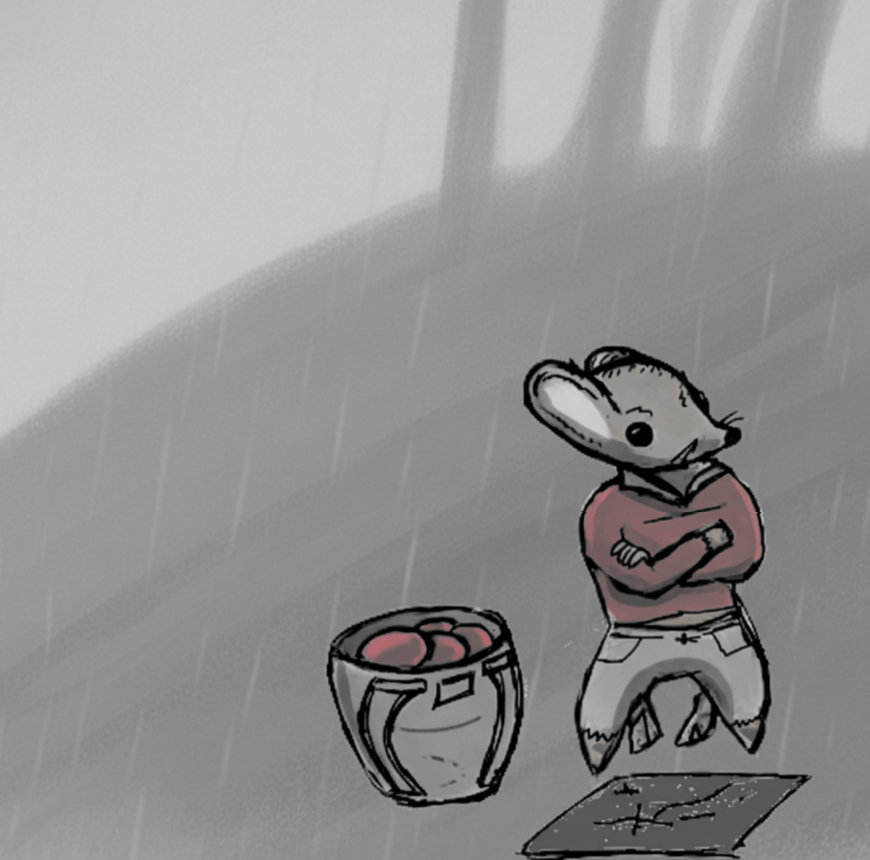
Wanting a creativity-assist when I was writing up NPCs to populate the town of Big Lick, I decided to write up a Python based tool to generate mouse-names suitable to my setting–mostly Appalachian plant names of one sort of another–and to try to come up with prompts to think about their dispositions, what sorts of mice they are (suspicious, kind, and so on). So I compiled a list of Appalachian plants, and a list of character traits, and then threw in most of the Mausritter char-gen on top of it, with some options to make the characters stronger or weaker, or higher level.
That would have been good enough for my needs, especially since I always have a Python environment handy. But it really wasn’t that much more to convert it into a simple one-page web app. Most of the data was already in python dictionaries, which is a short step or two away from being JavaScript objects, and nothing seemed too complicated, so I did it. I figured that when I do publish Spooked in the Hollers, players and GMs would find it a useful tool.
It truly is a one page-app. Its in one html file, with no external dependencies. Vanilla JavaScript, CSS, and even images (I used SVGs), are all embedded in the html file itself, so its quite portable, and works off line if you save the file to local storage.
I embedded it in this post, but it’ll be linked up at top of our site and have a dedicated page. Write now as an embedded iframe, which is easiest given that this website is driven by WordPress, but not particularly ideal (the file is merely a media file uploaded here at this link)
There are actually quite a few departures from how vanilla Mausritter does chargen, and these will end up as a custom procedure in the text of Spooked in the Hollers itself. The mouse names match my setting, of course. These are primarily, but not exclusively, common plant names for plants found in Appalachia, mostly native plants, but also introduced plants, particularly those of cultural or economic importance.
I’ve changed how birth signs are handled. First, birth signs are a combination of lunar phase and season. A birth sign might be the 3rd Waxing Moon of Winter, which, in the simplified mythical and game-play friendly calendar, corresponds to the waxing moon of the the third month of Winter (which here corresponds to March, not February). I’ll do another post on the calendar in the future. Birth signs will be tied mechanically into the game as some sort of effect on the character (perhaps they’ll get a luck token on their time of the year).
Dispositions, the character of mice, is also handled differently. Most importantly, it is *not* tied to birth signs. Dispositions are rolled independently, and a mouse receives 1 to 3 dispositions. I find that pairing multiple dispositions together can generate unexpected and interesting character portraits (what sort of mouse is clumsy, brooding, AND daring?).
But the biggest change to how vanilla Mausritter does char-gen is how backgrounds are handled.
In general, and to the best of my understanding, 18th, 19th and early 20th century Appalachia was divided into two socio-economic worlds: rural-life and town-life.
Rural life was predominantly subsistence farming, with supplemental hunting and foraging, and supplemental means of making a living which might involve selling food to towns’ people, driving livestock to markets, or working for wages (often seasonally).
Town-life, with professional specialists (merchants, lawyers, bankers, craftsmen, etc.) who asymmetrically depended upon generalist rural farmers for food, but also provided some essential services in return, namely either legal, or for things that farmers could not make on their own.
So I start with the assumption that 80% of the popular are rural, and 20% of the population are townsfolk. Once I’ve identified the mouse as rural or townsfolk, then that determines the backgrounds table they roll upon. Townsfolk roll on one table. Often that means that a mouse adventurer might be a former apprentice in the trades. Rural mice are a little different. A minority of rural mice (say 20%) were not primarily farmers (though most farmed some), but had some kind of profession. For example, you might be a salt maker, or a coal miner, or a raft hand, or even a holler preacher, traveling between communities trading sermons for supper.
But the majority were farmers. If starting equipment is determined by background, then I have a conundrum: do I want the majority of mice to start with the same item? No, and farming isn’t like other backgrounds; a farmer has to do a little of everything.
So, I had a few choices here, but I started first with the idea that these farmers are generalists who have to have a lot of competencies to get by. If you are raising your own corn, making your own cornmeal, making your own whiskey, making your own soap and candles, spinning your own thread, making your own clothes, butchering your own hogs, smoking your own meat, building your own houses, barns and fences, and treating your own sick, you obviously know how to do a lot of different sorts of things, things that town-dwelling specialists don’t have to.
Second, even if they were generalists, it doesn’t follow that every farmer was equally competent in everything. Some mice are known for being excellent cooks, others for being especially knowledgeable about caring for sick animals, others for being handy with carpentry, others who are admired for their hunting skills. And so, farmers roll two country competencies.
Its going to take more work to make sure its all balanced out how I like it. I may have to tweak how starting pips are given out; presumably townsfolk might have more pips on hand, for example, and since farmers end up with several background items, perhaps they should be given more pips to purchase what they need.
That is to say, its a work in progress!